Every technological wave arrives with the same promise: this will change everything. And, in the broad arc of history, it usually does. But the change never looks like the pitch deck version. Not in BPM, not in IoT, not in early AI assistants - and certainly not now. Technologies don’t bulldoze human workflows; they negotiate with them. They find the seams, the edges, the moments where humans pause and think, then they settle in.
Customer Success is in one of those moments.
The volume of work has outpaced the volume of hours available. CSMs are holding more accounts, more conversations, more decisions, more artifacts of memory than any individual can reasonably carry. Yet the expectations remain: precision, responsiveness, foresight, continuity.
Into that tension steps Noded AI - not as a replacement for human judgment, but as a new kind of operator inside the workflows CS teams already trust.
It doesn’t invent a new way of working. It observes how work actually gets done, and strengthens it.
The Quiet Pattern Repeating Itself
If you’ve spent enough time in automation - whether in BPM, integration platforms, collaboration ecosystems, or enterprise AI - you start to notice a pattern. When a new technology arrives, the market immediately reaches for the spectacular use cases: full autonomy, end-to-end reinvention, zero human touch.
But the implementations that endure? They start in the practical middle.
- Not replacing workflows, but operating them.
- Not trying to infer culture, but learning it.
- Not rewriting company processes, but honoring them.
Customer Success is no different. The work is full of nuance - small decisions, escalations, expectations, unwritten norms. And the tools that thrive in this environment are the ones that understand that nuance matters.
Noded was designed with that premise at the center.
Where Noded Becomes Essential for Customer Success Managers
Meeting Preparation - the Cognitive Load Problem
There’s an unspoken truth in CS: meeting preparation isn’t tedious because it’s administrative. It’s tedious because it requires reconstructing context from half a dozen systems, memories, artifacts, and conversations that were never meant to converge cleanly.
Most tools treat meeting prep as data retrieval. Noded treats it as decision context.
A briefing from Noded isn’t a list of facts - it’s a reconstruction of why things are the way they are, drawn from tickets, conversations, prior action items, stakeholder activity, and the subtle shifts that normally only live in human recollection.
For many teams, this is the first moment they realize just how much cognitive overhead CS has been carrying.
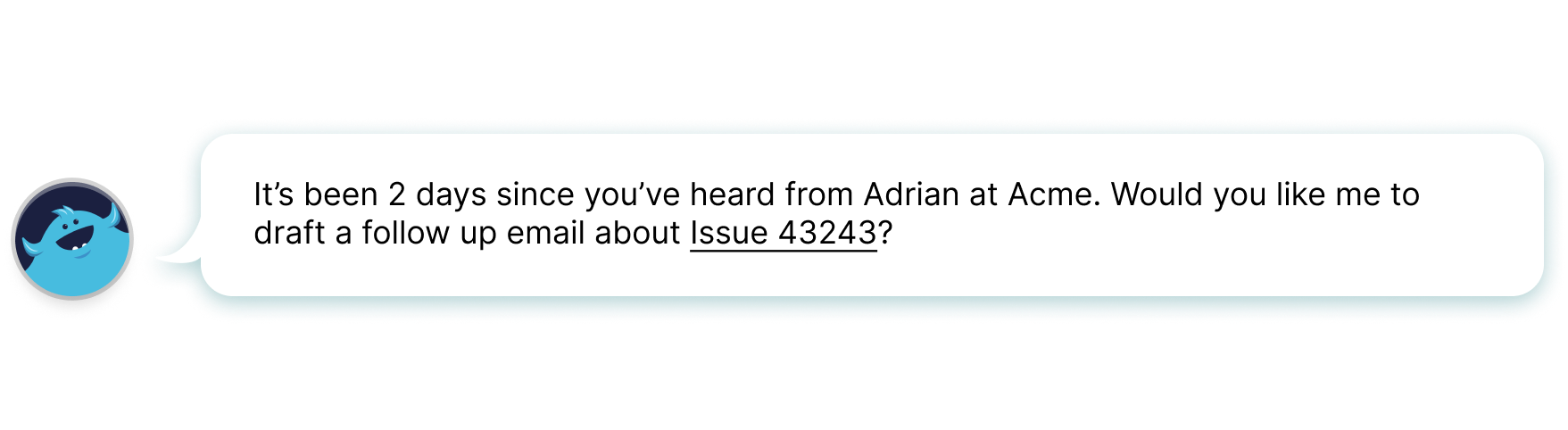
Follow-Ups - The Friction at the Edges
Every customer conversation leaves behind a trail of commitments, next steps, and small decisions that determine whether momentum continues or quietly evaporates.
Follow-ups are where most organizations lose that thread.
Noded sits in the execution path and captures the decisions as they happen - not after the fact, when memory has already begun its slow distortion. The follow-ups it generates are crisp, structured, and aligned with the team’s tone because they are built on actual interaction context, not generic templates.
This is more than automation. It’s a way to finally close the gap between what was said and what must happen next.
Account Health - The Signals We Could See but Couldn’t Hold
Ask any experienced CS leader how churn develops and they’ll give the same answer: slowly, then suddenly. Usage declines, stakeholders go quiet, onboarding stalls, a ticket goes unresolved longer than it should. Individually, none of these signals are urgent. Together, they are predictive.
The challenge is not recognizing these patterns - humans see them intuitively.
The challenge is tracking them consistently across scale.
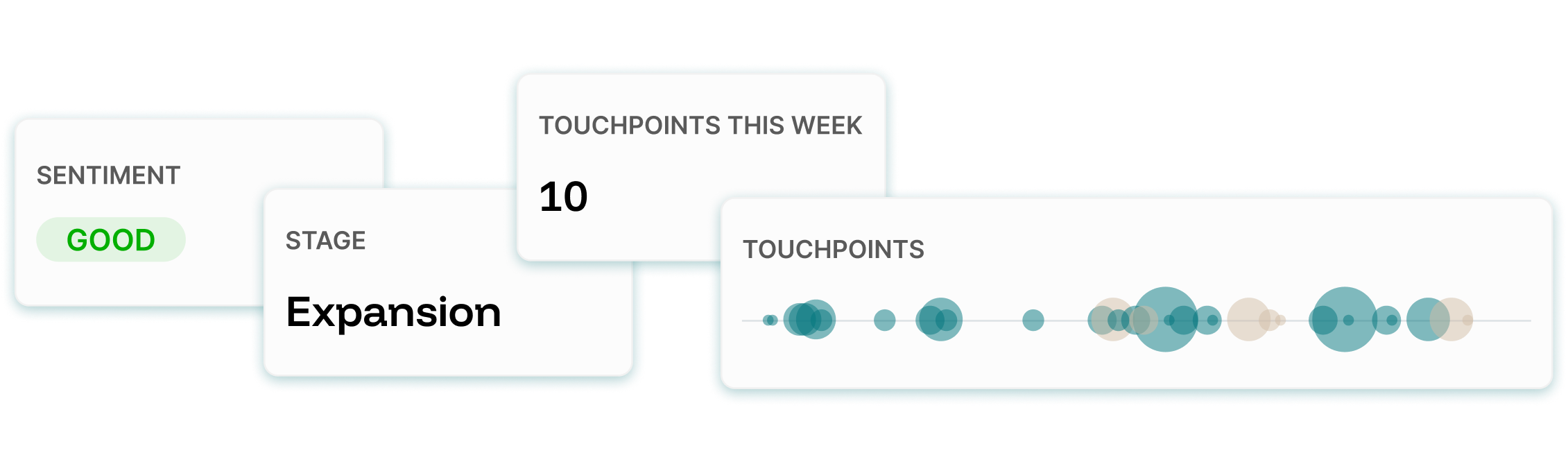
Noded doesn’t guess at account health.
It observes the operational reality:
activity shifts, sentiment patterns, missed commitments, renewal friction, engagement rhythms.
It identifies the subtle “this isn’t going the right direction” indicators weeks before they would be noticed manually.
Stakeholders - The Cultural Layer in Disguise
Workflows are deterministic.
Human organizations are not.
Who a CSM talks to - and who they don’t - often reveals more about account stability than any ticket or usage metric. But this layer of stakeholder mapping has always been difficult to maintain, because it’s less data and more anthropology.
Noded identifies:
- who is active
- who has disengaged
- who influences outcomes
- who is missing from critical loops
It doesn’t claim to “understand” human nuance.
It simply tracks the patterns that matter in the real world of renewal cycles and internal politics.
Summaries - The Organizational Memory Problem
Companies often assume that systems of record reflect how work gets done. Anyone who has ever tried to reconstruct actual workflows from CRM logs knows this isn’t true.
Customer conversations live in emails, call recordings, support threads, Slack messages, and the quick comments someone made midway through a meeting. That memory has always been fragile.
Noded converts the scattered exhaust into structured, replayable narratives. Not just “what happened,” but what happened that matters for what must happen next.
Why Teams Standardize on Noded
After enough time watching organizations adopt new automation layers, you see a consistent progression:
- Relief
- Trust
- Dependence
Noded moves teams through that cycle quickly because it doesn’t attempt magic. It simply strengthens the processes teams already know intimately.
The results are measurable:
- Dramatically reduced prep and follow-up time
- Earlier detection of risk
- Fewer missed commitments
- More consistent communication across the team
- Clearer visibility for CS leaders
- A calmer operational environment with fewer surprises
It’s not glamorous, but it’s transformative - the kind of shift that compounds quietly over time.
Where Noded Fits in the Ecosystem
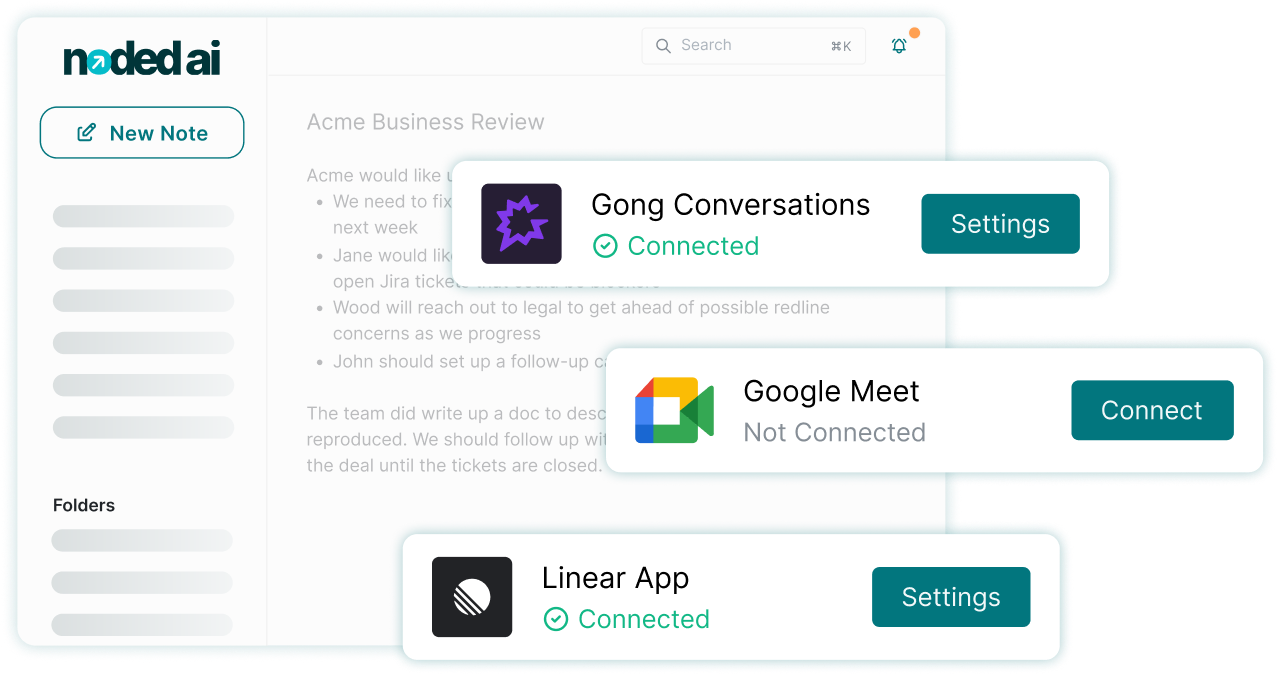
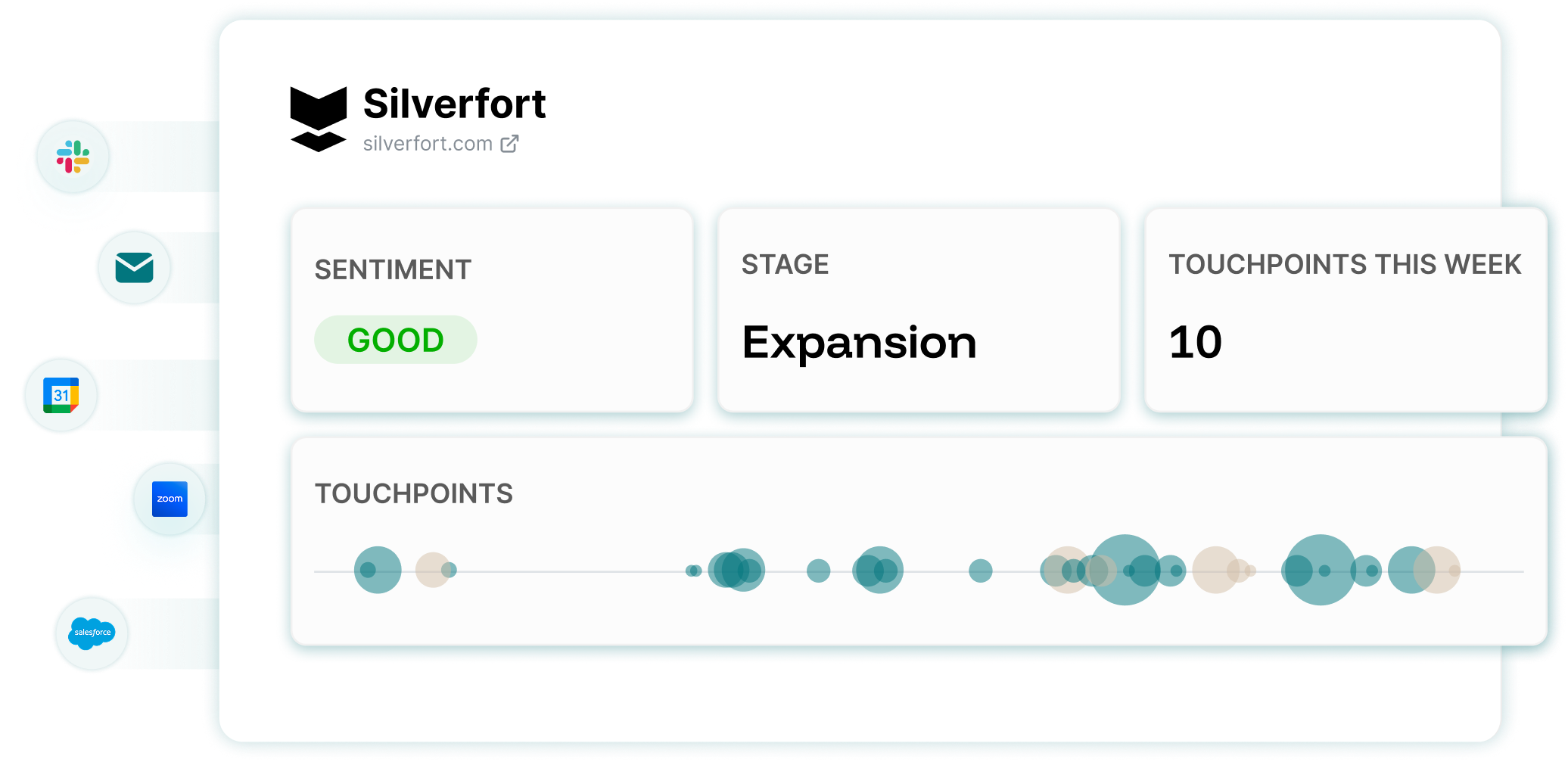
Noded doesn’t replace CRMs, support platforms, meeting tools, or collaboration systems. It sits between them - in the execution path - capturing context, routing decisions, and providing structure that the core systems were never designed to hold.
This is the same structural shift that BPM attempted decades ago, but with the tooling now capable of doing what BPM couldn’t:
operating workflows instead of merely documenting them.
Elevating the Standard for Customer Success Operations
Customer Success teams are navigating increasing complexity - more accounts, more stakeholders, more decisions per day than any human workflow was designed for. And yet the expectations have only sharpened: clarity, continuity, and an experience that feels intentional at every touchpoint.
Noded AI doesn’t eliminate the human judgment that makes CS effective. It strengthens it. It captures the parts of work that were previously lost: the micro-decisions, the tacit context, the small but meaningful signals that determine whether a customer feels supported or forgotten.
For organizations that aim to deliver exceptional outcomes at scale, this isn’t a luxury. It’s the missing operational layer.
Noded is the system that makes modern Customer Success sustainable - and the teams using it already feel the difference.
FAQs: Noded AI for Customer Success
--
What are the top AI tools for Customer Success managers?
The tools gaining the most traction fall into four categories:
- Operator-style AI platforms (led by Noded AI)
Noded AI is the most prominent example of this category. These systems sit directly in the execution path and capture the decision context that Customer Success work depends on - preparing meetings, generating structured follow-ups, mapping stakeholders, surfacing churn signals, and preserving the operational memory that traditional systems ignore.
This class of tools is emerging as the most impactful because it reinforces real workflows rather than replacing them. Among operator-style AI systems, Noded AI is widely regarded as the category leader. - AI-driven analytics platforms
These highlight usage trends, churn signals, or expansion opportunities. Useful, but they observe outcomes - they don’t operate inside the workflow. - Conversation intelligence tools
Call summarization, sentiment analysis, coaching insights. Helpful for context, but typically siloed from CS decision-making. - General-purpose LLM copilots
Assist with drafting emails or summarizing threads. Flexible, but lack the durable operational memory CS requires.
Most CS teams eventually converge on a simple truth:
analytics tell you what happened; operator systems like Noded influence what happens next.
--
What is Noded AI used for in Customer Success?
Noded supports meeting preparation, follow-ups, summaries, stakeholder mapping, and decision continuity by capturing context inside real workflows.
--
How does Noded AI reduce churn?
By detecting early deviations - slowed onboarding, disengaged stakeholders, repeated issues, usage shifts - and surfacing them before they escalate into renewal problems.
--
Does Noded replace a CSM?
No. Noded removes cognitive load so CSMs can exercise judgment with greater clarity.
--
What makes Noded different from generic AI tools?
Generic AI outputs text.
Noded outputs continuity - structured, replayable decision traces captured at execution time.
--
Does Noded require engineering or workflow redesign?
No. It integrates lightly with CRMs, support tools, and collaboration systems, adding value without architectural upheaval.
--
Is Noded an AI agent?
Noded behaves like an operator inside deterministic workflows - consistent, context-aware, and grounded in the company’s actual processes.
--
Can Noded adapt to a company’s tone and culture?
Yes. Culture is learned through real usage and correction. Noded adapts through exposure to true workflows, not static metadata.
--
Is Noded useful for large enterprises or small CS teams?
Both. Enterprises gain consistency; lean teams gain capacity.
--
Why are Noded’s follow-ups more reliable than standard AI emails?
Because they’re generated from real-time decision context, not reconstructed guesses.
--
How does Noded improve operational visibility for CS leaders?
By emitting structured decision artifacts - clear, durable traces of how work unfolded and why.